Expedia & Egencia Future of Travel Study

“Millennial” travelers – defined as those between 18 and 30 years old – have sharply different business and leisure travel habits and expectations than do their older peers, according to a global study released by Expedia.com® and Egencia®.
The Future of Travel study was conducted across five continents, asking 8,535 employed adults in 24 countries about how they conduct business and leisure travel – their likes, dislikes, preferences and pet peeves. The study aims to discover how millennials will impact the travel landscape as they gain decision-making power at work and purchase power in their personal lives.
The Future of Travel Study was conducted online between August 20 and September 12, 2013 by Harris Interactive on behalf of Expedia. Full details on the Future of Travel Study can be found on the Expedia® Viewfinder Blog here: viewfinder.expedia.com.

Sharp differences emerged in the Future of Travel analysis, particularly the differing value that younger travelers place on mobile and on loyalty. Millennials are far likelier to embrace loyalty programs while en route; half of millennials find loyalty programs important when booking flights (48%) or hotels (51%), versus only three in ten of travelers aged 46-65 (31% & 30% respectively).
Mobile and other form factors are clearly important to the future of travel. In fact, for booking business travel, 32% of those 30 and under report using a smartphone and 20% report booking on a tablet. That’s compared to just 12% for smartphone and 9% for tablet for those over 45. And 18-30 year-olds are far likelier than 46-65 year-olds to use mobile devices to enhance their travel experience.
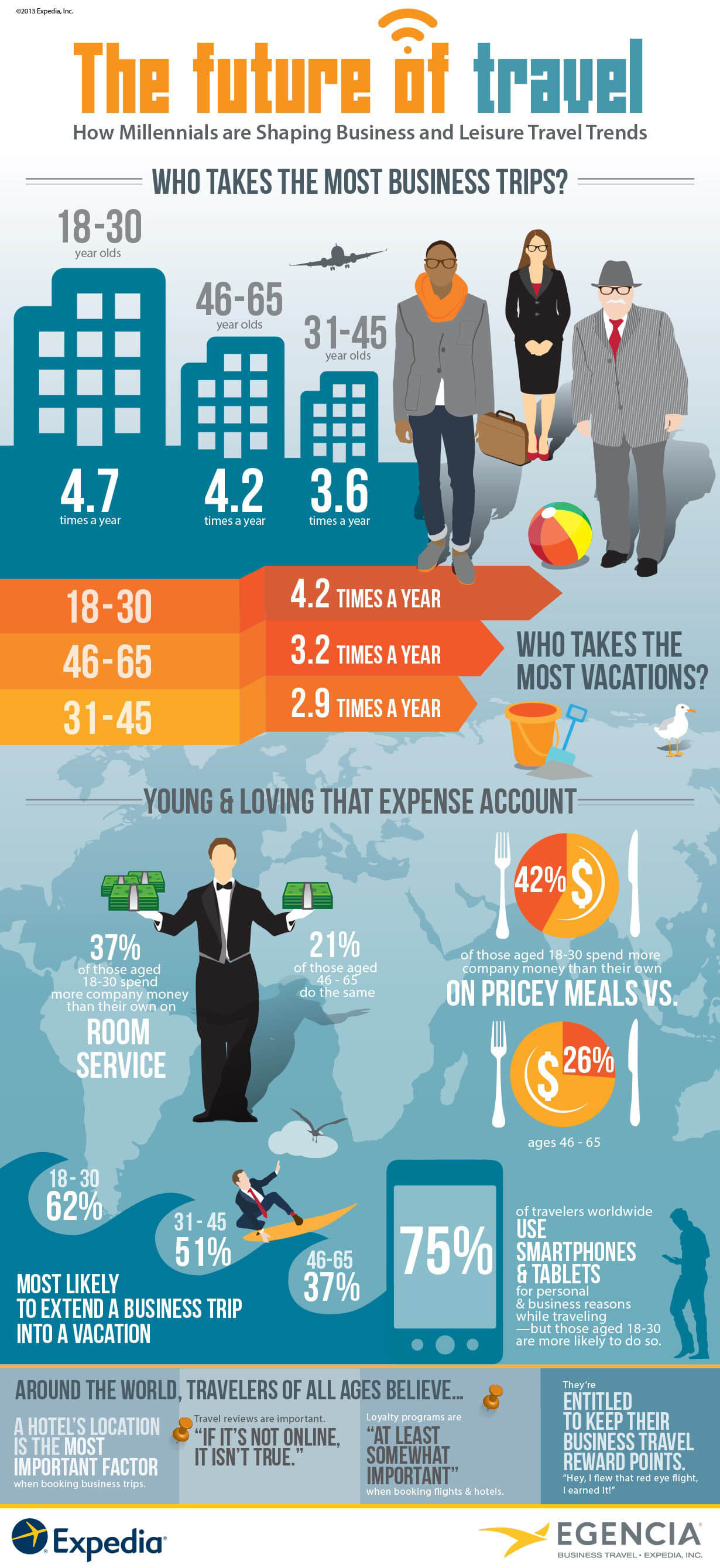
The study found that younger travelers were freer with their company’s money when traveling. Globally, business travelers aged 18-30 more frequently report that they will spend more of their company’s money on high-end meals (42%) than they would their own money compared to those aged 46-65 (26%). Millennials are also fans of room service: 37% would spend more of their company’s money on room service, versus only 21% of 46-65 year-olds.
Younger Americans (34 and under) are slightly more likely to spend company money on a flight upgrade to business- or first-class than are their older peers (35 and older). They are also slightly more likely to spend company money on high-end meals, room service and wine/alcohol, although not significant.
Millennials have more opportunities to order room service than any other age demographic, because they travel slightly more on business. Worldwide, 30-and-unders report traveling 4.7 times per year on business, versus 3.6 times per year among 30-45 year-olds, and 4.2 times per year among 46-65 year-olds. Millennials take more leisure trips as well, at 4.2 trips a year, versus 2.9 for 31-45 year-olds and 3.2 for 46-65 year-olds.
Among Americans, 45% of respondents aged 34 and younger claim to work fewer hours when they travel than they do at the office, versus 24% of Americans aged 35 and older.
Need a Fresh Marketing Perspective?
Ready to attract more of the right customers, improve your marketing performance, or simply need an experienced partner to guide your next steps? We'd love to help.
American and Canadian millennials travel more frequently of any age group across any nation, reporting that they take a full 7.8 leisure trips per year. On the contrary, European respondents aged 31-45 take 2.7 leisure trips per year.
“Together, Expedia.com and Egencia help many millions of business travelers book travel each year,” said Dara Khosrowshahi, chief executive officer, Expedia Inc., of which Expedia.com and Egencia are a part. “As millennials increase their decision-making power at work and at home, they’ll be increasingly disruptive in both areas of travel and our aim is to have the right mix of technology, supply and programs to make the most of every trip they take.”
“Business travelers are early adopters of technology—millennial travelers even faster—and all on the move from device-to-device, from online to offline and back again,” said Rob Greyber, president of Egencia. “We realize that keeping pace with millennials and future generations of corporate travelers demands significant focus on mobile in order to sustainably engage them with the right information.”
Greyber added that with the company’s upcoming global launch of Egencia® TripNavigator, a smart travel companion iPhone app, corporate travelers of today and tomorrow will be well equipped when on the road. The app helps travelers better navigate their in-trip experience by displaying a contextual, actionable view of the itinerary and integrating real-time trip alerts to reduce agony as travel plans change, expectedly or unexpectedly.
On the whole, the study found that:
- Millennials are more comfortable mixing business with pleasure. They are more likely to extend a business trip into a personal vacation than older employees are. 62% of 18-30 year olds have done so, vs. 51% of 31-45 year olds and 37% of 46-65 year olds. Younger Americans and Canadians are more likely to do this (70%), than those age 31-45 (50%) or 46+ (31%).
- 39% of all business travelers report that they work more hours when they travel than they do at the office. Europeans (45%) are more likely than Asia-Pacific (35%) and North American (32%) travelers to say that they work more hours than normal when traveling.
- Millennials are also more likely to voice their displeasure. 18-30 year old business travelers are likeliest to post a negative review online, as it relates to their experience with hotels, restaurants, flights, public transportation, taxis and rental cars. Negative reviews are still relatively rare, however; 67% of travelers worldwide have never done so. Reviews themselves are considered highly important for both business and leisure travel, particularly among Millennials as; eight in ten (77% and 82% respectively) 18-30 year olds worldwide consider travel reviews to be “very important” or “somewhat important.” This sentiment holds true across a majority of all age groups and regions.
- Americans under the age of 34 more frequently posted negative reviews of hotels (26%) within the last year, versus 14% of their older peers. Hotels received the most negative reviews among American business travelers, narrowly edging out restaurants. 66% of older Americans would not expect a response from the business they had negatively reviewed online, a skepticism shared by 65% of their younger peers.
- Mobile devices are nearing ubiquity for business travelers across all regions and all demographics, but more so for millennials than any other group, unsurprisingly. 75% of travelers surveyed worldwide use smartphones and tablets for both personal and business reasons when traveling.
- Location, location, location. Location matters over everything when business travelers book hotels, with travelers most frequently citing it as the most important feature (53%). The price of the hotel room (44%) narrowly edged out travel time to the city in question (42%) as next most-important features. Airfare price, at 36%, ranked fourth. In-flight Wi-Fi was not a high priority among business travelers worldwide, though in every region, the importance of in-flight Wi-Fi declines as travelers aged.
- For leisure travelers, hotel room price was among the top three most important features (63%).Hotel location and air fare price were tied, at 50%. On-board Wi-Fi was less important for leisure travelers than for business travelers, across all age groups and regions.
- When traveling on business, 83% of respondents worldwide feel that they should be personally entitled to travel reward points. Globally, workers under the age of 45 surveyed tend to feel more entitled to their points than older employees.
- A majority (68%) of employees are compensated for their business trips on nights and weekends, either with extra money or with additional compensation days. Across all regions surveyed, 18-30 year olds are more likely to be compensated with either money or added vacation time (78%).
- A majority of employees (67%) do tend to save some type of personal information online to streamline the booking process, however, one-third (33%) still prefer not to save any personal data online. Of the majority of respondents who save personal information online, millennial employees tend to be more comfortable doing so than their older counterparts.
Survey Methodology
This Expedia survey was conducted online from August 20, 2013 to September 12, 2013 across Europe, North America, South America and Asia Pacific by Harris Interactive among 8,535 respondents over the age of 18. In order to qualify to take the full survey, respondents had to be employed full time, part time or self-employed. For complete survey methodology, including weighting variables, please contact: expediapr@hlgrp.com.
The survey examined business and leisure travel attitudes and behaviors among the residents of Europe (United Kingdom, Denmark, France, Austria, Germany, Ireland, Italy, Spain, Sweden, the Netherlands and Norway), Asia Pacific (India, Japan, Malaysia, Hong Kong, Thailand, Singapore, South Korea, Australia, and New Zealand), North America (United States, Canada, and Mexico), and Brazil.
Let's Talk Strategy
Every business has unique marketing challenges. We'll help you identify opportunities, refine your messaging, and build a plan designed around your goals.
Let's Connect