
Advanced Search Engine Optimization Strategies for Modern Businesses

Search has changed more in the past eighteen months than it did in the previous five years combined. For businesses in August 2026, mastering Search Engine Optimization (SEO) is vital for online visibility: Over 60% of web traffic comes from search engines.
The digital world is always shifting. Search engines like Google update constantly, which creates both challenges and new opportunities. AI is also transforming how people find information. Generative AI tools are now part of the search experience. This means optimizing for “AI Overviews” and large language models (LLMs) is crucial, and understanding Generative Engine Optimization (GEO) is a new frontier. For those needing specialized help, expert generative AI SEO services can offer significant value in this new landscape.
In this extensive guide, we’ll break down key SEO strategies, cover foundational on-page techniques, dive into advanced technical SEO factors, and show you how to analyze your performance.
Key Foundations of On-Page Search Engine Optimization Strategies
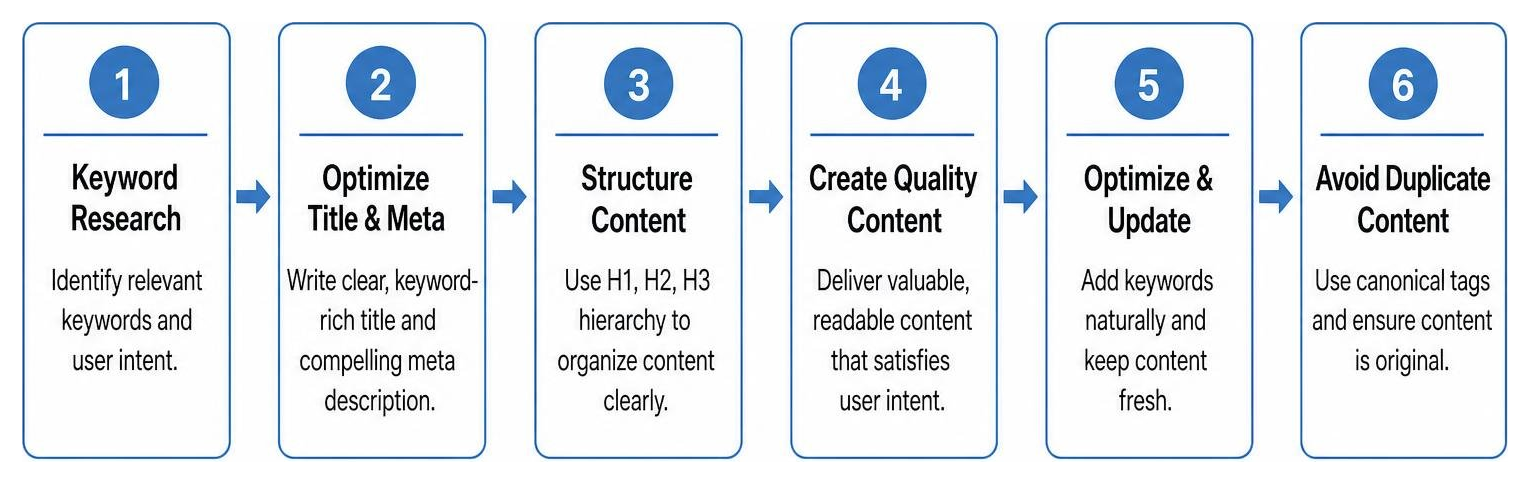
Effective on-page SEO begins with crafting content that serves both human users and search engine algorithms. This means optimizing elements directly on your web pages. Page titles and meta descriptions are paramount since they’re often the first impression users get in search results. Titles should be concise, descriptive, and include your primary keywords, ideally front-loaded. Meta descriptions, while not a direct ranking factor, act as a compelling sales pitch, encouraging clicks with clear value propositions and calls to action.
Header hierarchy, utilizing H1, H2, and H3 tags, is crucial for content structure and readability. A single H1 tag should define the page’s main topic, followed by H2s for major sections and H3s for subsections. This logical flow not only aids user comprehension but also helps search engines understand the content’s organization and key themes.
At the heart of on-page optimization is thorough keyword research. This involves identifying the specific terms and phrases your target audience uses to find information, products, or services. Beyond short, high-volume keywords, focusing on long-tail keywords (typically 3-5 words) can capture highly specific user intent and often leads to higher conversion rates. The key is to incorporate these keywords naturally into your content and avoid “keyword stuffing,” which can harm both user experience and search rankings. Following principles like the Plain Writing Act of 2010 keeps your content clear, concise, and accessible to a broad audience.
Content freshness and quality play a significant role. Regularly updating content with new information, statistics, and insights signals to search engines that your page is a relevant and authoritative source. Addressing duplicate content issues through canonicalization (telling search engines which version of similar content is the “master”) prevents dilution of ranking power.
Finally, the E-E-A-T framework (Experience, Expertise, Authoritativeness, Trustworthiness) is a guiding principle for creating high-quality content. Demonstrating genuine experience, deep expertise, strong authority, and unwavering trustworthiness in your content is essential for long-term success. For businesses looking to refine these foundational elements and more, comprehensive online marketing services can provide tailored strategies.
Technical Execution and Generative Search Engine Optimization Strategies
Beyond on-page content, a robust technical foundation is critical for search engine visibility. Site speed and mobile responsiveness are non-negotiable in August 2026. Google’s Core Web Vitals (CWV) metrics – Largest Contentful Paint (LCP), Interaction to Next Paint (INP), and Cumulative Layout Shift (CLS) – directly measure page experience and significantly influence rankings. Optimizing these metrics ensures a fast, stable, and interactive user experience.
Structured data, implemented using Schema markup (often in JSON-LD format), is another powerful technical SEO strategy. This code helps search engines understand the context and meaning of your content, allowing for rich snippets and enhanced appearances in search results. For example, marking up product reviews, FAQs, or event details can make your listing stand out.
The rise of AI has introduced Generative Engine Optimization (GEO). This specialized approach focuses on optimizing content for generative AI search tools and AI Overviews, which synthesize answers and cite sources directly in search results. Our goal is to position your content as a citable, authoritative source for large language models (LLMs).
This involves structuring content with clear, direct answers, strong E-E-A-T signals, and potentially utilizing emerging standards like the llms.txt file to signal authoritative content to AI crawlers. Prompt research, analyzing the natural language questions users ask AI, is becoming as vital as traditional keyword research. Businesses navigating this new terrain can benefit greatly from expert generative AI SEO services to ensure their content is discoverable and cited in AI-driven search experiences.
Crawling, Indexing, and Search Engine Mechanics
To understand how to rank, we must first understand how search engines operate. Web crawlers, like Googlebot, are automated programs that systematically discover new and updated web pages. They follow links from page to page and collect information about the content they find. This discovery process is known as crawling.
Once a page is crawled, the search engine analyzes its content and adds it to its massive database, a process called indexation. An XML sitemap acts as a roadmap for crawlers, listing all the important pages on your site and helping ensure they are discovered and indexed efficiently. Conversely, the robots.txt file instructs crawlers which parts of your site they should or should not access. While robots.txt can prevent crawling, a noindex meta tag is required to reliably prevent a page from appearing in search results even if it’s crawled.
Site architecture, referring to how your website’s pages are organized and linked, significantly impacts crawlability and indexation. A logical, hierarchical structure helps crawlers navigate and understand your site. This also affects your “crawl budget,” the number of pages a search engine crawls on your site within a given timeframe.
Internal linking, strategically placing links from one page on your site to another, distributes “link equity” and helps crawlers discover new content while reinforcing the relevance of linked pages. External links, or backlinks from other reputable websites, are powerful signals of authority and trust. Building a strong backlink profile is crucial, and the anchor text used in these links provides important contextual clues to search engines about the linked page’s topic.
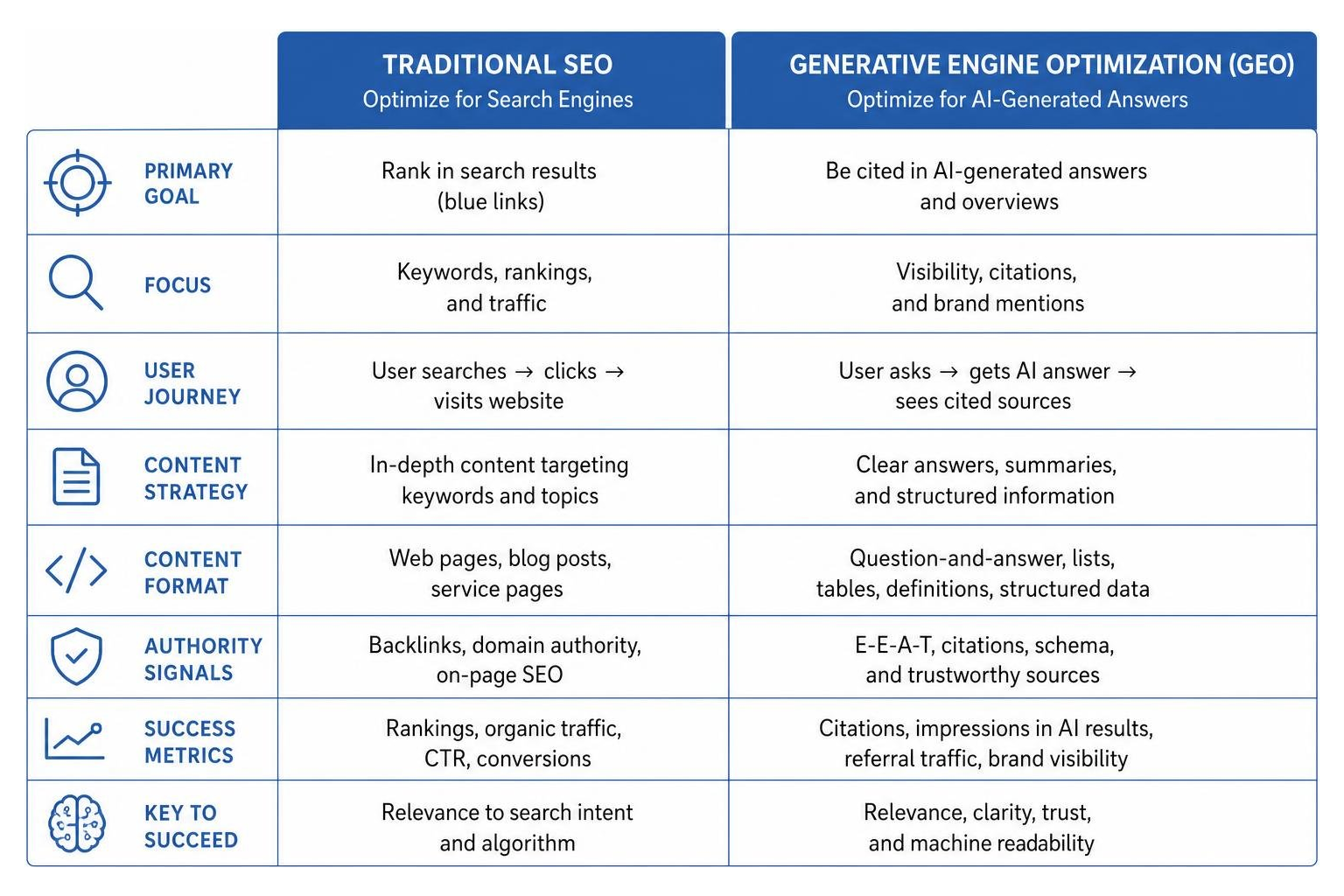
Here’s a comparison of how traditional SEO and Generative Engine Optimization (GEO) approach visibility:
Need a Fresh Marketing Perspective?
Ready to attract more of the right customers, improve your marketing performance, or simply need an experienced partner to guide your next steps? We'd love to help.
Generative Engine Optimization versus Traditional Search Frameworks
While traditional SEO focuses on earning “blue link” rankings in search results, Generative Engine Optimization (GEO) extends this to encompass visibility within AI-generated answers, such as Google’s AI Overviews, ChatGPT, and other LLM-powered interfaces. This shift necessitates a refined approach to content creation and strategy.
Search intent mapping becomes even more critical. We need to understand not just what users are searching for, but why they are searching and what kind of answer they expect. For AI Overviews, this often means providing clear, direct, and factual answers to common questions upfront. Answer Engine Optimization (AEO) is about structuring content to be easily extractable and citable by AI, often by placing concise summaries or definitions at the beginning of sections. The best approach is to develop a strategy that balances SEO, AEO, and GEO.
Google’s “AI Mode” and its “query fan-out” technique, where a user’s initial query is broken down into sub-topics to generate additional search queries, highlights the need for comprehensive, topically authoritative content. Citation optimization focuses on ensuring your content is recognized as a primary, trustworthy source when AI synthesizes information. This often involves strong source attribution within your own content and building entity authority around your brand and expertise.
The rise of “zero-click searches,” where users get answers directly from the search results page (often via an AI Overview) without visiting a website, means you can still gain brand visibility and authority through citation, even if traffic isn’t directly driven. Building content clusters and pillar pages – comprehensive guides on broad topics supported by detailed sub-articles – is an effective strategy to establish this deep topical authority, making your site a go-to resource for both traditional search and AI overviews.
Technical Performance, Core Web Vitals, and Mobile Optimization
In August 2026, mobile-first indexing is the standard. This means Google primarily indexes and ranks the mobile version of your content. Therefore, optimizing for mobile devices is not just a best practice; it’s a fundamental requirement. Page load speed, a critical part of user experience, directly affects rankings. Slow-loading pages lead to higher bounce rates and poorer search performance.
To enhance speed, we focus on several technical aspects:
- Image compression and modern formats: Converting images to formats like WebP significantly reduces file sizes without sacrificing quality.
- Browser caching: Storing parts of your website on a user’s browser reduces load times for repeat visitors.
- Minifying CSS and JavaScript: Removing unnecessary characters from code files speeds up rendering.
- Optimizing JavaScript execution: Ensuring efficient code that doesn’t block the main thread.
Core Web Vitals remain crucial. LCP measures perceived load speed, INP measures interactivity, and CLS measures visual stability. Regular technical site audits are essential to identify and fix issues like redirect chains (multiple redirects that slow page loads) and to ensure proper tap targets (buttons and links that are easy to tap on mobile). Beyond performance, adhering to Section 508 accessibility guidelines ensures your website is usable for everyone, including those with disabilities, which also contributes to better overall user experience signals. For organizations seeking to fine-tune these intricate technical elements and integrate them into a broader strategy, data-driven SEO services can provide invaluable expertise.
Analytics, Google Search Console, and Performance Tracking
Measuring and analyzing your SEO performance is as crucial as implementing the strategies themselves. Google Search Console (GSC) is an indispensable, free tool that provides direct insights into how Google views your site. It allows us to monitor organic traffic, impression trends, and click-through rates (CTR). We can use GSC to identify top-performing queries, spot indexing issues, and use the URL inspection tool to see how Googlebot renders specific pages.
Google Analytics 4 (GA4) complements GSC by offering a deeper understanding of user behavior on your site. By integrating GA4, we can track user engagement, conversion paths, and the true business impact of organic traffic. Analyzing search query reporting in GSC helps us refine keyword strategies, while understanding conversion context in GA4 ensures our SEO efforts align with actual business goals.
Regular content auditing is vital. This involves reviewing existing content for accuracy, relevance, and performance. Identifying and removing Redundant, Outdated, and Trivial (ROT) content helps maintain a lean, high-quality site. It also allows us to identify opportunities for content refreshes or consolidation. By consistently tracking these metrics and conducting audits, we can make informed, data-driven decisions to continuously improve SEO performance.
The Strategic Advantage of AuraSearch
In this rapidly evolving digital landscape, achieving and maintaining search visibility requires a sophisticated, adaptive approach. AuraSearch™ specializes in Generative Engine Optimization, ensuring your business is not only found in traditional search results but also cited and recommended in AI Overviews and other generative AI platforms. Their strategies are designed for multi-platform search visibility, preparing your content for today’s and tomorrow’s search landscape.
The company applies a cross-industry strategy, understanding that while SEO fundamentals remain, their application must be tailored to specific market dynamics and audience behaviors. Their commitment to transparent analytics means you always have a clear view of your performance, understanding the true impact of our efforts on your organic growth and business objectives. They believe in human-led AI, using cutting-edge technology to enhance strategic thinking and execution rather than replace the critical human element.
Ready to transform your search presence and capitalize on the opportunities of the AI-driven search era? Reach out to the team to discuss your unique needs or explore their services.
FAQs
Q: What is the key difference between traditional SEO and Generative Engine Optimization (GEO)? A: Traditional SEO focuses on optimizing websites to rank higher in standard search engine results pages (SERPs) with “blue links.” GEO, on the other hand, specifically targets visibility within AI-generated answers, such as Google AI Overviews and responses from large language models (LLMs), aiming for content to be cited as an authoritative source.
Q: How do search engines like Google discover, crawl, and index web pages? A: Search engines use automated programs called web crawlers (e.g., Googlebot) to discover new and updated web pages by following links. This process is “crawling.” Once discovered, the content is analyzed and added to the search engine’s database, known as “indexing,” making it eligible to appear in search results.
Q: What are the “good” benchmarks for Core Web Vitals (LCP, INP, CLS)? A: As of August 2026, Google’s Core Web Vitals thresholds for a “good” user experience are: Largest Contentful Paint (LCP) ≤ 2.5 seconds, Interaction to Next Paint (INP) ≤ 200 milliseconds, and Cumulative Layout Shift (CLS) ≤ 0.1.
Q: How does structured data (Schema markup) benefit search result appearance? A: Structured data helps search engines understand the specific context of your content, allowing them to display “rich snippets” or enhanced features in search results. This can include star ratings, product prices, event dates, or FAQ toggles, making your listing more prominent and informative and potentially increasing click-through rates.
Q: What are some common SEO mistakes to avoid? A: Common SEO mistakes include keyword stuffing (over-optimizing with keywords), having duplicate content without proper canonicalization, ignoring mobile-friendliness, neglecting site speed, building low-quality backlinks, and failing to regularly update or audit content.
Q: How can Google Search Console be used to improve SEO performance? A: Google Search Console (GSC) provides data on how your site performs in Google Search. You can use it to monitor organic traffic, identify top-performing keywords, check for indexing issues, submit sitemaps, inspect individual URLs, and receive alerts about potential problems, all of which inform strategic SEO adjustments.
Let's Talk Strategy
Every business has unique marketing challenges. We'll help you identify opportunities, refine your messaging, and build a plan designed around your goals.
Let's Connect