
How to Create a Content Strategy That Balances SEO, AEO, and GEO

Creating a content strategy that seamlessly integrates Search Engine Optimization (SEO), Answer Engine Optimization (AEO), and Generative Engine Optimization (GEO) is crucial for brands and publishers seeking to succeed in today’s rapidly evolving digital landscape. Each optimization method targets different platforms, including traditional search engines, AI-driven answer engines, and generative AI tools. Each of these plays a crucial role in enhancing content visibility and audience engagement.
Relying solely on keywords or conventional SEO tactics is no longer sufficient to capture attention in search results. Modern success depends on understanding how users search, ask questions, and interact with AI-powered systems. Implementing AEO techniques helps ensure that content provides precise answers to user queries, increasing its chances of being featured in snippets and AI-generated results. By strategically combining SEO, AEO, and GEO in content planning, brands can build a digital presence that is both resilient and prepared for future trends.
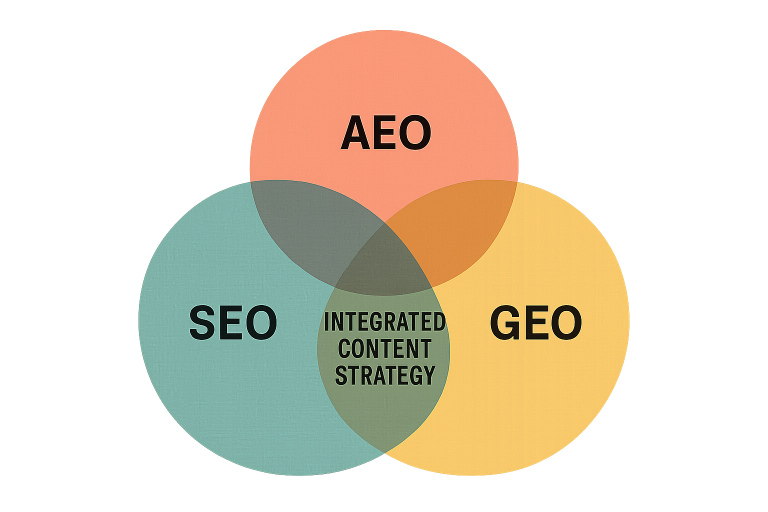
Understanding SEO, AEO, and GEO
SEO, AEO, and GEO represent distinct content optimization strategies that intersect at the point of maximizing your online impact. Here’s what distinguishes each approach:
- SEO (Search Engine Optimization): Concentrates on boosting your visibility in search engines like Google and Bing through keyword research, quality writing, comprehensive topic coverage, and authoritative backlinks.
- AEO (Answer Engine Optimization): Optimizing content for direct answers to user queries not only boosts traditional search visibility but also enhances performance in AI-driven answer engines. According to the Forbes Business Council, the future of SEO increasingly revolves around Answer Engine Optimization (AEO), which emphasizes content that aligns closely with user intent. Focusing on clarity and precision ensures your content can be surfaced in features like “featured snippets,” voice search responses, and other AI-powered experiences.
- GEO (Generative Engine Optimization): Targets the requirements of generative AI platforms, aiming to be cited, summarized, or referenced in AI-generated answers. This often requires concise, factually sound information and the use of machine-readable formats.
While the tactics for each overlap, their end goals and platforms differ. An integrated approach ensures your content is equipped for both established and emerging search behaviors.
Integrating SEO, AEO, and GEO into Your Content Strategy
Successfully merging SEO, AEO, and GEO starts at the content planning stage. Here is how you can overlay these disciplines into a unified, powerful strategy:
Need a Fresh Marketing Perspective?
Ready to attract more of the right customers, improve your marketing performance, or simply need an experienced partner to guide your next steps? We'd love to help.
- Content Layering: Develop content structured in layers. Start with a concise executive summary, ideal for an AI overview and quick answers. Follow with a Q&A-driven section designed for answer engines, then dive into in-depth analysis and supporting data for SEO authority. For a detailed exploration of how AEO and GEO tactics can yield surprising SEO insights, see this review by Search Engine Journal.
- Schema Markup: Use JSON-LD or other appropriate schema types for your content to give clear context to search engines and answer engines. This improves your chances of appearing in rich results and featured snippets.
- Topical Authority: Develop comprehensive content clusters centered on key themes and ideas. Robust coverage of related subtopics signals authority to search engines and improves your performance across multiple query types.
This layered approach maximizes your chances of being surfaced in traditional searches, voice searches, and generative AI responses.
Implementing Structured Content and Schema Markup
Organizing your content for both human readers and search engines is foundational for optimization. Use headers (H2, H3), subheadings, tables, and bullet lists to create a clear structure and improve skim ability. AI parsers and answer engines tend to prioritize logically structured and well-formatted text.
Schema markup provides crucial metadata, helping search engines recognize the type, context, and key points of your content. Properly applied schema supports rich snippets, like FAQs, reviews, and featured answers, driving higher engagement and CTR.
Regular Content Updates and E-E-A-T Principles
Search algorithms reward up-to-date, credible content. Regularly audit and update articles, adding new statistics, addressing emerging questions, and refreshing examples, to maintain relevance and authority. This signals to engines that your page remains current and valuable for users.
Applying the E-E-A-T (Experience, Expertise, Authoritativeness, Trustworthiness) model enhances trust signals. Feature clear author bios, establish credentials, cite reputable sources, and demonstrate first-hand knowledge or experience. These practices are crucial for competitive queries, particularly in fields such as health, finance, or technology.
Conclusion
Blending SEO, AEO, and GEO is not just a best practice, but an imperative for modern content strategy. By structuring your content for both human and AI consumption, implementing schema markup, updating it regularly, and emphasizing E-E-A-T, you create a digital presence capable of winning in both traditional SERPs and next-generation generative engines. Investing in a holistic, agile strategy will keep your content discoverable, useful, and influential in years to come.
Let's Talk Strategy
Every business has unique marketing challenges. We'll help you identify opportunities, refine your messaging, and build a plan designed around your goals.
Let's Connect