
Digital Marketing Trends for Small Businesses in 2026

As digital marketing continues to evolve rapidly, small businesses need to stay on top of new trends to remain competitive in 2026. Adapting to the latest digital strategies not only drives customer engagement but also increases efficiency and profitability. Now more than ever, embracing emerging trends is essential for businesses aiming to connect with their target audience and stand out in a crowded market. Whether you are updating your website, launching a campaign, or collaborating with a local web developer Abilene TX, adopting these trends can redefine your approach to online marketing.
Businesses that are proactive rather than reactive in their digital marketing investments tend to achieve better ROI and foster lasting customer relationships. Technology is pushing the boundaries of what’s possible. From AI-driven automation to new ways consumers interact with brands, the landscape for small businesses is becoming more dynamic and accessible than ever. In this environment, leveraging the right digital tools can mean the difference between stagnation and growth.
Integration of Artificial Intelligence (AI)
AI has moved from a futuristic concept to a standard business tool, especially for small businesses eager to streamline their marketing operations. According to projections, the vast majority of small and medium-sized enterprises will use at least one AI-powered marketing solution this year. These tools enable companies to automate repetitive tasks such as customer communication, content recommendations, and advertising optimization.
More importantly, AI provides the intelligence behind personalized email campaigns, product recommendations, and real-time chatbots, ensuring every customer interaction feels relevant and timely. As businesses integrate AI solutions into everyday marketing, they benefit from increased operational efficiency and improved customer experiences.
AI is transforming marketing in many ways. It’s also playing a significant role in analyzing customer behavior. Data-driven insights empower businesses to fine-tune their messages and offers, segment audiences with precision, and predict trends before they emerge. For small businesses tackling big competition, this level of analysis is invaluable. Platforms such as Google’s AI-based analytics continuously evolve to deliver real-time decision-making capabilities previously unavailable to smaller organizations.
Dominance of Short-Form Video Content
The surge of platforms like TikTok, Instagram Reels, and YouTube Shorts has shifted consumers’ attention spans toward quicker, more bite-sized content formats. Short-form videos now command some of the highest engagement rates across digital channels. Businesses that prioritize this type of content experience a marked increase in brand awareness and interaction. Short-form video offers companies an opportunity to showcase products, tell stories, and highlight customer testimonials, all in moments that align with today’s fast-paced digital consumption habits.
In 2026, authenticity and creativity drive the most successful short-form video campaigns. For small businesses, creating relatable and informative content requires minimal equipment and budget but delivers outsized results. Small business owners should focus on spontaneous, behind-the-scenes glimpses or how-to videos that encourage their audience to share and comment. Adapting quickly to trends and actively engaging with the audience in this format is key.
Need a Fresh Marketing Perspective?
Ready to attract more of the right customers, improve your marketing performance, or simply need an experienced partner to guide your next steps? We'd love to help.
Voice Search Optimization
Over half of American consumers now use voice assistants on smartphones and smart speakers for local searches. As this trend accelerates, optimizing websites and content for voice search is no longer optional. Success in voice search hinges on adapting to natural language queries and focusing on conversational phrases and long-tail keywords. Structuring web content so that voice assistants can easily parse answers boosts the likelihood of being featured in voice-driven results.
For local businesses, this optimization directly increases visibility in “near me” searches and drives in-person visits from interested customers. Implementing structured data markup and using FAQ-style content helps search engines understand your offerings, making it easier for your business to be recommended by virtual assistants. Additional insights on the impact of voice search are available from Search Engine Land.
Growth of Social Commerce
Social media channels like Instagram, Facebook, Pinterest, and TikTok are continually rolling out enhanced shopping features. Social commerce eliminates the friction between product discovery and purchase, allowing customers to buy directly on their favorite platforms. In-app checkout and shoppable posts have revolutionized the conversion funnel, with many businesses reporting conversion rate increases of up to 30 percent compared to traditional website-based sales.
Participation in live shopping events, creative influencer collaborations, and interactive product launches drives results. Small businesses that experiment with these tactics can grow their social followings and increase sales. It is essential to consistently track performance across social commerce initiatives to optimize the mix of content, messaging, and influencer partnerships. As consumer preferences shift, agility and responsiveness will define the winners in this space.
Emphasis on First-Party Data Collection
Increasing privacy regulations and the elimination of third-party cookies have put greater emphasis on collecting data directly from customers. First-party data, such as information gathered from email sign-ups, loyalty programs, purchase histories, or direct interactions, allows businesses to create more accurate customer profiles. With this information, companies can send targeted offers, recommend relevant products, and nurture long-term customer relationships. The result is higher open rates, more conversions, and increased loyalty without compromising user privacy.
Investing in transparent, customer- and business-friendly data collection methods builds trust while ensuring compliance with privacy standards. For guidance on managing first-party data and privacy, visit this breakdown from The Wall Street Journal.
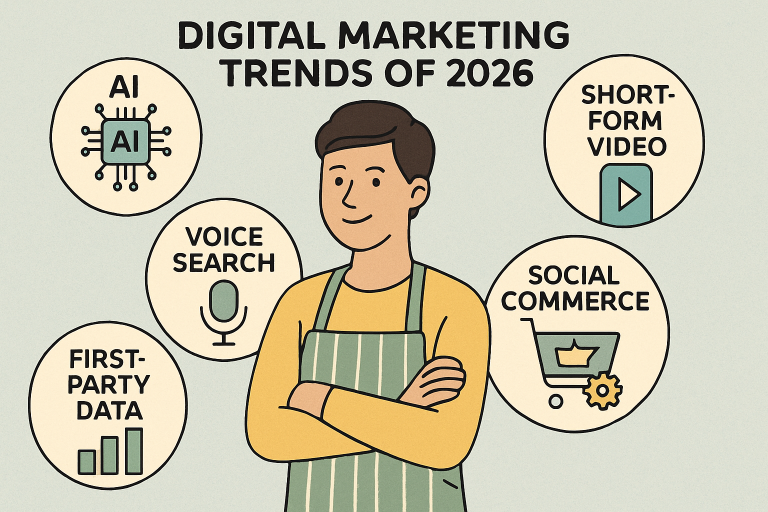
Staying abreast of digital marketing trends enables small businesses to reach broader audiences, operate more efficiently, and achieve greater success in 2026 and beyond. By integrating AI, embracing short-form video, fine-tuning for voice searches, leveraging social commerce, and building powerful first-party data assets, businesses can thrive, adapt, and grow amid evolving technology and consumer expectations.
Let's Talk Strategy
Every business has unique marketing challenges. We'll help you identify opportunities, refine your messaging, and build a plan designed around your goals.
Let's Connect