
The Synergy Between Digital Marketing and Web Design
The digital landscape is a dynamic ecosystem where web design and digital marketing are not just complementary but intrinsically linked. A website serves as the central hub for comprehensive digital marketing efforts and the primary touchpoint for potential customers.
Its design dictates the initial user experience, which in turn profoundly influences conversion rate optimization. When a website is intuitively designed, users can easily navigate, find information, and complete desired actions, directly boosting marketing campaign effectiveness.
This symbiotic relationship ensures brand consistency across all online channels. A well-designed site reinforces brand identity, making marketing messages more impactful and memorable. From an organic visibility perspective, search engines favor websites that offer a superior user experience, making effective design a prerequisite for strong SEO performance.
A unified approach lets businesses build seamless multi-channel funnels and guide customers through their journeys with greater precision and engagement.
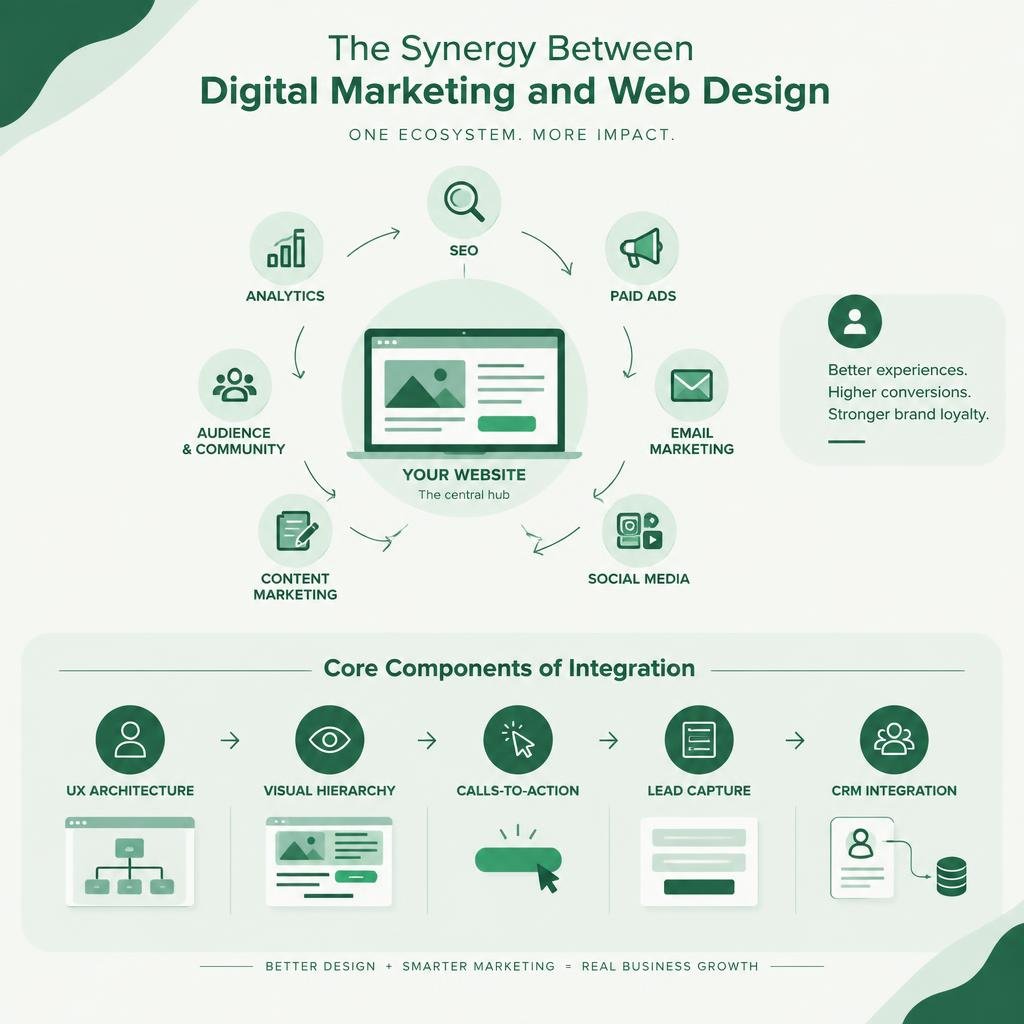
Core Components of Digital Marketing and Web Design Integration
Effective integration of web design and digital marketing depends on several core components that work together to achieve business objectives. At the foundation is robust UX architecture, which meticulously plans the user’s journey through the site, ensuring every interaction is intuitive and purposeful. Visual hierarchy supports this by guiding the user’s eye to the most critical elements on a page, from headlines to calls-to-action.
Clear calls-to-action (CTAs) are paramount; they directly prompt users to take the next step, whether it’s making a purchase, signing up for a newsletter, or requesting a demo. Efficient lead-capture mechanisms, such as well-placed forms and pop-ups, convert interested visitors into actionable leads.
Finally, seamless CRM integration ensures that these captured leads are automatically fed into a system for nurturing and follow-up, closing the loop between initial website interaction and long-term customer relationship management. This holistic approach ensures that design choices directly serve marketing goals, transforming website visitors into valuable business assets.
Graphic Design vs. Digital Marketing: Distinct Disciplines Working Together
While often intertwined, graphic design and digital marketing are distinct disciplines, each with its unique focus and skill set. However, their collaboration is essential for creating a compelling and effective online presence.
Digital marketing, by contrast, focuses on strategy, data analytics, and campaign management across digital channels. Marketers decide where and how to deploy these visual assets to reach target audiences, drive engagement, and achieve measurable business outcomes. They manage SEO, content marketing, social media, email campaigns, and paid advertising, constantly analyzing performance data to optimize their efforts.
When these two disciplines work together, the results are powerful. Graphic designers provide the visually engaging content that digital marketers use to capture attention and convey messages. Marketers provide insights into audience preferences and campaign performance, allowing designers to create visuals that are not only beautiful but also highly effective in achieving marketing objectives. This synergy ensures that a brand’s online presence is both aesthetically pleasing and strategically impactful.
How Web Architecture Directly Influences SEO and Conversion Rates
A website’s underlying architecture is a critical determinant of its success in both search engine rankings and converting visitors into customers. A well-structured site is not just about aesthetics; it’s about performance, usability, and discoverability.
Key elements like site speed, adherence to Core Web Vitals, mobile responsiveness, and intuitive navigation structure directly impact how search engines crawl and rank a site, as well as how users engage with it. If a site is slow, hard to use on mobile, or difficult to navigate, both search engines and users will quickly abandon it, leading to lower rankings and missed conversion opportunities.
Technical Performance and Search Engine Visibility
For search engines like Google, technical performance is a significant ranking factor. Search engines prioritize websites that load quickly and offer a smooth user experience. This is where Core Web Vitals come into play, measuring real-world user experience for loading performance (Largest Contentful Paint – LCP), interactivity (First Input Delay – FID), and visual stability (Cumulative Layout Shift – CLS).
Optimizing LCP, for instance, means ensuring a page’s main content loads as fast as possible, often by optimizing images, minifying CSS and JavaScript, and leveraging browser caching. Clean CMS architecture is also vital, ensuring that the code is streamlined and free of unnecessary bloat, which can hinder loading times and crawlability.
Furthermore, implementing structured data (schema markup) helps search engines better understand a page’s content, leading to richer search results and improved visibility. A technically sound website essentially speaks the search engine’s language, making it easier for algorithms to index and rank content appropriately.
User Experience, Trust Signals, and Conversion Optimization
Beyond technical performance, web design profoundly influences user experience (UX), which is directly tied to trust and conversion rates. About 95% of users consider a website’s design crucial to their trust in a business. A visually appealing, well-organized, and easy-to-use website signals professionalism and reliability.
Incorporating social proof, such as customer testimonials, reviews, and case studies, can significantly build credibility and encourage conversions. Design should create intuitive pathways that guide users effortlessly toward their goals, whether they’re finding information or making a purchase. This includes clear navigation, logical content organization, and accessible information.
Form optimization is another critical area; forms should be concise, easy to complete, and clearly indicate progress. Moreover, accessibility compliance, particularly adhering to standards like WCAG 2.1, ensures that websites are usable by everyone, including individuals with disabilities.
This not only broadens a site’s audience but also shows a commitment to inclusivity, building trust and improving the overall user experience. When users trust a site and find it easy to use, they are far more likely to convert.
Strategic Pillars for Driving Business Growth Online
To achieve sustainable business growth in the digital age, a robust online strategy must extend beyond just having a functional website. It requires a multifaceted approach built on several strategic pillars.
Establishing an omnichannel presence ensures that a brand engages with customers consistently across all touchpoints, from social media to email to in-person interactions. This unified experience builds stronger relationships and reinforces brand messaging.
Effective brand storytelling is crucial for connecting with audiences emotionally, differentiating a business from competitors, and fostering loyalty. Weave this narrative throughout all digital content and design elements. A well-defined lead-nurturing strategy is also essential to guide potential customers through the sales funnel, provide valuable information, and build trust over time.
Finally, robust customer retention programs, often facilitated through personalized digital interactions, are key to maximizing customer lifetime value and fostering long-term growth. For businesses looking to refine their approach, integrating a comprehensive marketing strategy and social media presence is often the next logical step.
Incorporating Brand Identity into Digital Experiences
A powerful brand identity is more than just a logo; it’s the essence of what a business stands for, and it must be consistently reflected across all digital experiences. This integration begins with color psychology, where specific hues evoke desired emotions and perceptions.
For example, blues often convey trust and stability, while greens might suggest growth or nature. Unified typography ensures readability and reinforces brand personality, whether it’s modern and sleek or classic and elegant.
Interactive elements, such as animations, quizzes, or dynamic content, can bring a brand’s personality to life and increase engagement. The tone of voice used in all written content—from website copy to social media posts—must align with the brand’s persona, whether it’s authoritative, friendly, or innovative.
Cross-platform cohesion is vital; the brand identity should feel consistent and recognizable across the website, social media profiles, email campaigns, and any other digital touchpoints. This consistent application builds recognition, trust, and a strong, memorable brand presence.
Need a Fresh Marketing Perspective?
Ready to attract more of the right customers, improve your marketing performance, or simply need an experienced partner to guide your next steps? We'd love to help.
2026 Trends Reshaping Digital Marketing and Web Design
As we move further into 2026, the digital landscape continues to evolve rapidly, driven largely by advancements in artificial intelligence and changing user behaviors. One of the most significant shifts is the rise of Answer Engine Optimization (AEO).
As AI-powered search experiences become more prevalent, users increasingly seek direct answers and summaries rather than lists of links. This requires content to be optimized not just for keywords, but for clarity, conciseness, and its ability to directly answer user queries, making AI search readiness a critical component of modern SEO.
Conversational interfaces, including chatbots and voice assistants, are becoming more sophisticated and integrated into websites, offering personalized and immediate user support. This trend highlights the importance of natural language processing and intuitive dialogue flows.
Interactive UI elements are also gaining traction, moving beyond static pages to deliver more engaging, dynamic user experiences. This includes micro-interactions, immersive animations, and personalized content delivery, all designed to capture and retain user attention in an increasingly competitive digital space. Businesses that adapt to these trends will be better positioned to connect with their audiences and drive growth.
Evaluating and Selecting the Right Web Design and Marketing Partner
Choosing the right web design and marketing partner is a pivotal decision for any business aiming to elevate its online presence. The selection process should be thorough, focusing on more than just initial impressions.
Start by reviewing their portfolio to assess the quality and diversity of their past work, and look for projects that align with your brand’s aesthetic and functional needs. Seek partners with full-service capabilities—those who can offer a holistic approach spanning strategy, design, development, SEO, and ongoing marketing.
Transparency in pricing is non-negotiable; understand exactly what is included in their services and avoid hidden fees. Ask about their experience with scalable tech stacks to ensure they can build a foundation that supports future growth and technological advancements.
Finally, consider their approach to ongoing maintenance and support, as a website is a living entity that requires continuous care, security updates, and performance optimization to remain effective. A true partner will be invested in your long-term success.
Agency vs. Specialized Studio: Aligning Business Needs
When seeking a web design and marketing partner, businesses often face the choice between a full-service agency and a specialized studio. Each has distinct advantages, and the best fit depends on specific business needs and goals.
A full-service agency typically offers end-to-end management, providing a comprehensive suite of services from initial strategy and branding to web development, digital marketing, and ongoing support.
This can be ideal for businesses seeking a single point of contact and a cohesive strategy across all digital touchpoints, often leading to streamlined communication and consistent brand messaging. They usually have larger teams with diverse expertise and can handle complex projects.
Conversely, a specialized studio might excel in a particular area, such as custom architecture development, a specific platform (like Webflow or Shopify), or a niche design style. These studios often develop faster in their area of expertise and can provide highly tailored solutions for specific technical challenges.
While they may not offer the full breadth of marketing services, their deep expertise can be invaluable for projects that require specialized technical support or a unique platform selection. The decision hinges on whether a business requires a broad, integrated approach or a highly focused, expert solution for a particular aspect of their digital presence.
Frequently Asked Questions About Digital Marketing and Web Design
Understanding the interplay between web design and digital marketing often brings forth several common questions. Here, we address some of the most frequent inquiries to provide clarity and actionable insights.
How does web design directly impact organic search rankings?
Web design significantly influences organic search rankings through several critical factors. Page speed is paramount; slow-loading sites deter users and search engines penalize them. Mobile friendliness is another non-negotiable, as Google prioritizes mobile-responsive designs in its indexing. A well-structured site architecture with clear navigation helps search engine crawlers understand and index content more efficiently.
Furthermore, user engagement metrics like dwell time (how long users stay on a page) and bounce rate (how quickly they leave) are indirect signals of content quality and user experience, both heavily influenced by design.
Finally, meeting Core Web Vitals criteria directly impacts SEO, as these metrics measure the real-world user experience of loading, interactivity, and visual stability. A user-friendly, fast, and accessible design is inherently SEO-friendly.
What is the difference between SEO and Answer Engine Optimization (AEO)?
Traditional SEO (Search Engine Optimization) primarily focuses on optimizing content to rank high in traditional SERPs (Search Engine Results Pages), aiming to drive organic traffic through keyword relevance, backlinks, and technical optimization. The goal is often for a website to appear as a top result when users search for specific terms.
Answer Engine Optimization (AEO), on the other hand, is an emerging discipline focused on optimizing content for AI-powered search engines and conversational interfaces (like Google AI Overviews, ChatGPT, or Perplexity).
Instead of just ranking for keywords, AEO aims for content to be directly used in AI summaries, featured snippets, or as direct answers to conversational queries. This requires content to be highly structured, factual, concise, and authoritative, making it easy for AI models to extract and present accurate information directly to users. It also means many brands see a rise in “invisible traffic.”
While SEO still matters, AEO represents a shift towards optimizing for understanding and direct utility in an AI-driven search landscape. The ultimate goal is to create a strategy that balances SEO and SEO.
How often should a business update or redesign its website?
The frequency of website updates or redesigns varies, but a general guideline is to consider a significant redesign every 3-5 years. However, continuous optimization is more important than infrequent, large-scale overhauls. This involves regular technical maintenance, security updates, and content refreshes. Smaller, iterative design improvements can be made more frequently based on analytics data and evolving user needs.
A full redesign may be necessary if there’s a significant shift in brand identity or business goals, or if the current site no longer performs well in user experience, mobile responsiveness, or conversion rates. Staying current with design trends and technological advancements is crucial to maintain a competitive edge and ensure the website remains a valuable asset.
Conclusion
In 2026, strategically combining digital marketing and web design is fundamental to success. We’ve explored how a well-crafted website serves as the cornerstone of all online efforts, directly influencing SEO, conversion rates, and brand perception.
From the critical impact of Core Web Vitals and mobile responsiveness to the strategic integration of brand identity and the emerging importance of Answer Engine Optimization, every element plays a vital role in building a robust online presence.
For businesses aiming for long-term scalability and sustainable digital growth, the path forward involves a unified approach. This means continuously testing and refining strategies, embracing the latest technological trends, and ensuring seamless execution across all digital touchpoints.
By investing in a cohesive strategy that combines insightful digital marketing with exceptional web design, businesses exceed audience expectations. This is vital to fostering trust, driving engagement, and ultimately achieving growth objectives.
Let's Talk Strategy
Every business has unique marketing challenges. We'll help you identify opportunities, refine your messaging, and build a plan designed around your goals.
Let's Connect