
Law Firm Marketing: Nine Effective Digital Marketing Tactics

Today, more and more businesses rely on digital marketing to take their ventures to the next level. Businesses need more than customer referrals and walk-ins. Law firms and lawyers are no exception and must use targeted marketing strategies to succeed.
When people need to know something, all they need to do is type their questions into Google. Your law firm should adopt online marketing to secure clients. Otherwise, your competitors will snatch them from you. Apply these nine digital marketing tactics to make your law firm’s marketing strategy more effective:
Determine Your Goals
Marketing aims to get more clients and increase your law firm’s revenue. However, not everyone knows how to write goals that are specific, measurable, attainable, relevant, and time-bound. Let’s say your overall goal is to increase your gross revenue. Here’s how you can make it S.M.A.R.T:
- Specific: Instead of saying that you want to increase your law firm’s gross revenue, indicate how much increase you want. For example, increase the law firm’s revenue by $500,000.
- Measurable: This refers to how and when you will measure your success. Do you want all that revenue to increase from your marketing efforts? Are you going to set milestones for every quarter?
- Attainable: Do not fall into the trap of setting impossible goals. So, if you want to increase your law firm’s gross revenue by $500,000, check if you achieved such a stunt in the past. Otherwise, look for a growth trend during the past three to five years and start from there.
- Relevant: Not all goals are worth pursuing. In your law firm’s case, an increase in gross revenue can be appropriate since that would mean better compensation for your employees, higher dividends for your investors, or more funds that you can use for pro bono cases.
- Time-bound: Of course, everything must have a deadline. Can you not chase a goal for the rest of your life? For this example, you can say that you want to increase your law firm’s gross revenue by $500,000 within the next 12 months.
Why do you need a S.M.A.R.T. goal? Because your goal sets your marketing direction.
Develop and design your website
If you don’t have one yet, your law firm must have an official website. This will be the starting point of your online presence. In fact, your law firm’s website is what ties your online marketing strategies together.
As Dennis Dimka points out, “So much of the other components of a marketing plan, like SEO, PPC, and email marketing, tie back to your website.” Keep in mind that your website must have the following characteristics:
- Easy to navigate
- Mobile-friendly
- Loads fast
- Succinct “About Us” page
- Visible contact information
Communicate this with your web developer. If you already have a website, now is a great time to update and modernize it.
Improve Visibility with Search Engine Optimization
According to MOZ, search engine optimization (SEO) is “the practice of increasing the quantity and quality of traffic to your website through organic search engine results.” Simply put, SEO is the process of making your website visible on search engines like Google or Bing without paying them.
Say you are a personal injury lawyer, and your law firm is based in San Diego, California. If you apply SEO to your site, you should appear when someone types in “personal injury lawyer San Diego” on Google. SEO is a long, ongoing process that takes time to show results. Nonetheless, optimizing your website, when done correctly, can help generate a steady stream of potential clients in the long run.
Run an Optimized PPC Campaign
If there is an unpaid way to make your website visible in search results, there is a paid way. Pay-per-click (PPC) advertising is when you pay search engines to make your law firm’s website visible for relevant keywords.
However, you only need to pay a search engine when someone clicks on your ad. But why run a PPC campaign instead of using the money to put up a billboard along a national highway? Here’s the thing: Not everyone who would pass by the national highway is your potential client.
But when someone types “personal injury lawyer San Diego” into Google, that shows intent to hire a personal injury lawyer. So you have to be there. That’s how PPC can help make your law firm’s website visible online.
Attract Prospects Through Inbound Marketing
SEO and PPC are not just digital marketing techniques. They are also integral to your inbound marketing strategy. Inbound marketing refers to marketing tactics that help you bring qualified traffic to your online asset (i.e., your website).
However, it doesn’t end with bringing traffic to your website through SEO and PPC. You also need to ensure they land on a specific, valuable part of your website. Using our earlier example, when someone comes to your website after searching for “personal injury lawyer San Diego,” you might present your Homepage, about page, or contact us page.
Need a Fresh Marketing Perspective?
Ready to attract more of the right customers, improve your marketing performance, or simply need an experienced partner to guide your next steps? We'd love to help.
But if someone lands on your website for “What is a personal injury lawyer?” you might need to create and optimize a different online asset.
Setup Email Marketing Campaigns
There is a reason you should apply inbound marketing for your law firm. This helps you capture leads or potential clients and nurture them until they eventually hire you. One way to do that is through email marketing.
But when it comes to nurturing potential clients, you should not bombard them with something salty. Instead, create an automated newsletter campaign to make them feel you care about them.
That said, your email marketing campaign should be relevant. For example, if you send a newsletter to a past client, it can be because you are offering a discount if he hires your legal services again. It could also be because you are offering an incentive if he refers you to a new client.
Develop a Solid Social Media Marketing Strategy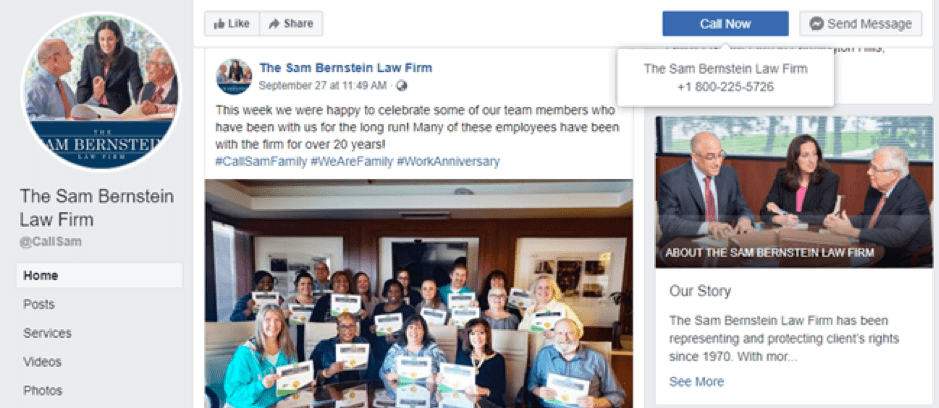
Another way to draw and nurture potential leads is through social media marketing. While you don’t need to be on every social network, you should be where most of your potential clients are. So, for a personal injury lawyer, this could mean having a Facebook page for your law firm.
That’s because most people post about how they were injured on their Facebook account. You can also create a Quora account to answer legal questions related to your practice.
Engage Your Visitors with Video Marketing
More than half of the general internet traffic will be from video by 2021. This means now is the best time for your law firm to engage in video marketing. Luckily, producing a video no longer costs a fortune. You can create a video using your smartphone. As for your law firm, here are some video content ideas:
- Question-and-answer video regarding your legal practice
- Interview other known lawyers in the field
- Webinar on “personal injury law” if you are a personal injury lawyer
You can also use videos to promote the causes you support. Regardless, make your video content beneficial for your viewers and potential clients. That way, you can establish your law firm’s credibility.
Generate a Content Marketing Strategy
Lastly, your law firm must have a content marketing strategy. Here’s what would happen if you do not have one:
- You have nothing to publish on your website
- You have nothing to share on social media
- You have no emails to send
- You have no topics to talk about on your video
To kick your content marketing strategy off the ground, you can start by setting up a blog for your law firm. Like in many industries ‒ such as health, food, and beauty ‒ wherein the marketing landscape has moved online, you must embrace the change if you want your law firm to acquire new clients.
You’ll need an effective online strategy that grabs attention and helps you prove your worth. If you need help with social media, email marketing, SEO, or any other general content marketing needs, contact Social Hospitality for a complimentary consultation.
Author Bio: Bryan Mixon owns AmazeLaw, where he builds websites for solo and small firm attorneys. He has been building websites since 1999 and has spent the last four years helping companies like HubSpot, Mill33, and LivingSocial. Bryan knows firsthand how hard it can be for small business owners to get their digital marketing off the ground, so he built AmazeLaw as a super-simple place for solo attorneys to build their sites, collect leads, and get back to doing lawyerly things.
Let's Talk Strategy
Every business has unique marketing challenges. We'll help you identify opportunities, refine your messaging, and build a plan designed around your goals.
Let's Connect